
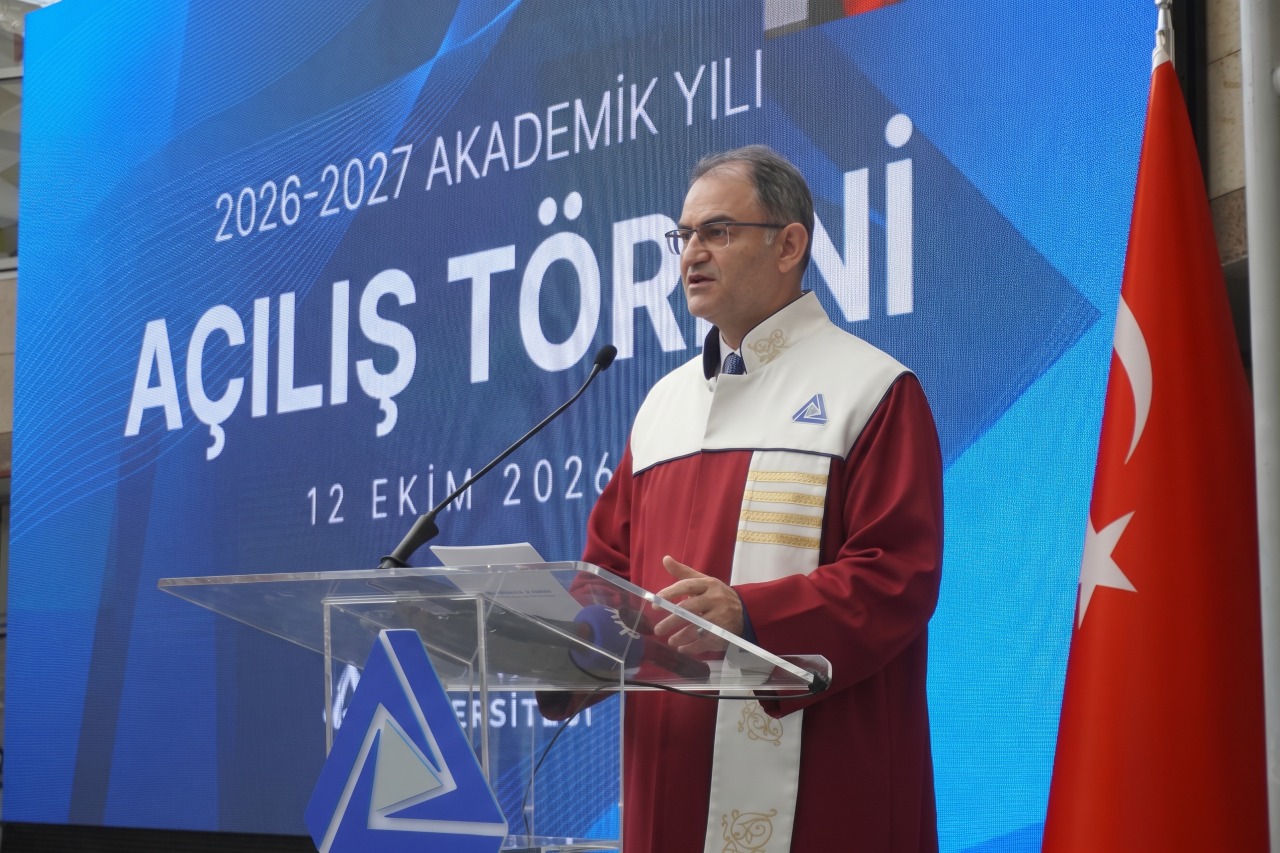
2026–2027 Academic Year Opening Address
Honorable Minister,
Esteemed Chair and Members of the Board of Trustees,
Distinguished faculty members and colleagues,
Dear students and esteemed guests,
I greet you all with respect, affection, and sincerity.
It is a great honor and pleasure for me to be with you at the Ankara Bilim University 2026–2027 Academic Year Opening Ceremony.
Honorable Minister, your presence among us, despite your busy schedule, is of immense value to our university and our students. I thank you for honoring us with your participation.
We have gathered here today to welcome a new academic year. However, I believe this gathering holds significance beyond merely marking the start of an academic year.
For a university's opening ceremony is not simply a day when new classes begin.
At the same time, this is an important opportunity to evaluate the period we have left behind and to reflect together on where we aim to be in the future.
Today, I would like to share with you the development Ankara Science University has undergone since its inception, the point it has reached today, and our goals for the coming years, as well as to express our faith in the university's future.
Founding a university is one of the most tangible expressions of confidence in the future.
For when you establish a university, you do not consider only the needs of the present. You must also consider young people who have not yet reached university age, the professions that will emerge in the future, scientific questions for which we currently have no answers, and the societal issues we will face years from now.
Ankara Science University began its educational journey in 2020 with this very mindset.
On this journey—undertaken with the support of our founding body, the Turkey Productivity Foundation, and our Board of Trustees—we have covered significant ground in a relatively short time.
We cannot say that the six years since our university’s founding have been an easy period. During a time of profound transformation for the world and higher education, we established our academic structure, developed our programs, strengthened our academic staff, and grew alongside our students.
Looking back today, we see not only a growing university but also an academic community that is steadily gaining strength.
Behind this progress lie our Board of Trustees, who believed in the university’s establishment and provided the necessary resources; our academics, who have dedicated their knowledge and effort; We have administrative staff working with great dedication and students who are here because they place their trust in our university.
As you know, the true strength of a university lies not in its buildings, but in the people who work and create within them.
Today, Ankara Science University is a higher education institution that continues to grow through its faculty, academic programs, students, alumni, research activities, and international relations.
During our founding years, our priority was to establish a strong and sustainable academic foundation.
Today, however, we are focusing on building upon that foundation to enhance the quality of education, expand our research capacity, offer more opportunities to our students, and strengthen the university's contribution to society.
For us, what matters is not merely the number of students we have or the number of programs we offer. ...the kind of education our students receive at the university, the competencies they possess upon graduation, the scientific contributions made by our faculty members, and the value our university creates for our country.
I believe that a university's success becomes evident in the achievements of the individuals it cultivates over time. Therefore, we prioritize monitoring the development and employment of our graduates, enhancing our students' experiences, improving the quality of our scientific research, and strengthening our international academic collaborations.
For we know that, in order to be meaningful, growth must go hand in hand with quality......we are...
One of the most important questions facing higher education today is this:
For what kind of future are we preparing our young people?
We believe that the answer to this question can no longer simply be providing a good vocational education.
We live in a world where artificial intelligence is changing the way we work, sustainability has become a fundamental responsibility for all sectors, and new professions are emerging while existing ones undergo transformation.
In such a world, it is not enough for universities merely to transmit existing knowledge. We need to ensure that our students learn how to learn, question, draw upon diverse disciplines, identify problems, and develop solutions.
In this regard, we find the educational approach introduced by our Ministry of National Education—the "Century of Türkiye Education Model," which integrates knowledge with skills and values—to be significant and meaningful.
Because... The various levels of education are not independent of one another; rather, they are complementary stages of the same long journey. We believe that the knowledge and skills acquired during primary and secondary education should be transformed into research, production, and societal benefit at the university level.
We are shaping our educational approach at Ankara Bilim University based on this philosophy.
In this context, we have integrated the topics of artificial intelligence and sustainability into our courses and academic programs.
This is because we want every student—regardless of their field of study—to understand the opportunities offered by artificial intelligence and the responsibilities that come with it.
Likewise, we want them to understand that sustainability is not merely a concept related to the environment; ...recognize that it also concerns our economic decisions, modes of production, resource utilization, and responsibilities toward society.
We also view the acceptance of four of our university’s side events within the scope of COP31 as a tangible and gratifying outcome of our efforts in the field of sustainability.
However, acquiring knowledge is merely one stage of education.
The real issue is the ability to apply the knowledge gained.
Guided by this idea, we have assigned an important task to our students:
Each of our students will prepare a project every year.
I attach particular importance to this approach.
Because we do not want our students' years at the university to be remembered solely for exams and course grades.
We want them to reflect on a new problem each year, conduct research, encounter diverse perspectives, make mistakes when necessary, and try again.
A project developed by one of our students might well provide a solution to a social issue. Someone else's project will evolve into a new design, piece of software, technological product, or startup idea.
Of course, not every project may turn into a patent or a commercial product.
However, every project will enhance our students' skills in thinking, researching, collaborating, and creating.
Sometimes, the most valuable thing a university instills in a student is the ability to say, in the face of a problem they encounter, “I can develop a solution for this.” ...is the courage to say so.
We aim to make this courage an integral part of our students' educational journey.
--
We believe that knowledge generated at the university should not remain confined within its walls.
Beyond merely uncovering new information, one of the most vital aspects of scientific research is its potential to contribute to human life and society.
For this reason, we view university-industry collaboration as a key component of our development strategy.
We seek to combine the scientific expertise of our academics with the needs of the industry, and the ideas of our students with real-world challenges.
Joint research, applied projects, entrepreneurial activities, and the development of new technologies are essential elements of this approach.
One of our primary goals for the upcoming period is to establish a technology development zone affiliated with our university.
We do not view this goal merely as a physical investment.
Our students...We aim to create a vibrant innovation ecosystem where R&D projects, our academics' research, entrepreneurs' ideas, and industry needs converge.
We want the knowledge generated at the university to transform into new technologies, new ventures, skilled employment, and societal benefit.
This will be a significant step for our university's future.
--
As we prepare for the future, we also face another question:
What kind of university should we be?
This question points to a crucial issue we must address alongside our growth.
For in strategic management, the essential thing is not merely to conduct more activities, but to determine the right priorities.
Ankara Bilim University will continue to grow through new academic programs.
However, we do not view growth solely as an increase in the number of programs and students.
We consider the human capital that Turkey and the world will need in the future, scientific and technological advancements, and the transformation of sectors... ...and we are taking our university's academic strengths into account.
While strengthening our existing programs, we will also expand into new fields.
In doing so, we do not wish to be a university confined to the boundaries of a single discipline. Conversely, we believe it is not right to be an institution that attempts to grow in every area simultaneously, thereby dissipating its academic energy.
Our goal is to be a university that—while maintaining robust academic diversity—deepens its expertise in specific areas and brings together different disciplines around shared challenges.
Technology, humanity, and a sustainable future are the complementary, fundamental elements of this approach.
UNESCO’s educational perspective extending to 2050 also reminds us that universities cannot limit themselves to merely training people for the professions of today.
The universities of the future; ...will be institutions that support lifelong learning, foster interdisciplinary collaboration, utilize technology for the benefit of humanity, and generate solutions to societal problems.
We aim to develop Ankara Science University with this very mindset.
For this reason, in the coming years, we regard lifelong learning opportunities, training aimed at acquiring new skills, and micro-credentials as integral components of our academic development.
This is because education is no longer a process that concludes with a graduation ceremony; it is becoming increasingly important for individuals to acquire new knowledge and competencies throughout their lives.
--
We are shaping the future of Ankara Science University through a robust development strategy grounded in educational quality, scientific productivity, and societal contribution.
Our priorities are to enhance student satisfaction, [advance] artificial intelligence... ...and to disseminate sustainability practices, ensure that every student develops a project, and continuously improve our academic performance.
In line with the Higher Education Quality Council’s quality assurance approach, we prioritize continuous improvement across all our activities—from education and research to administration and societal contribution.
While strengthening our academic diversity through new programs designed to meet future human resource needs, we aim to specialize in specific research areas and enhance our international visibility.
Deepening university-industry collaborations, expanding our capacity for entrepreneurship and technology transfer, and establishing a technology development zone are also among our priorities.
We aspire to build an Ankara Science University that is recognized at both national and international levels for the success of its graduates, the high-quality research of its faculty, the technologies it develops, and its contributions to society.
Because adapting to change and shaping change are not the same thing;
Our goal is to be a university that not only prepares for the future but also contributes to shaping it through science and education.
--
We must also not overlook the responsibility that education bears toward society. A student's success at university does not begin the day they walk through the university gates.
TodayThe dedication of the teachers who nurtured them plays a vital role in the lives of every young person studying at our university. We see a significant reflection of this dedication in the success demonstrated by recent PISA results.
Behind that success lies not only the support of their families but also the patience, guidance, and immense effort their teachers have invested over the years.
Universities represent a crucial stage in this long educational journey.
Our responsibility is not merely to prepare our young people for a profession; it is also to help them grow into individuals who embrace scientific thinking, respect for diverse viewpoints, social responsibility, and a culture of coexistence.
It is within this framework that we embrace the goal of a Turkey free from terrorism.
We believe that education plays a vital role in strengthening social harmony, trust, and a shared sense of the future.
Universities; ...institutions where diverse views can be expressed respectfully, issues are addressed through knowledge and reason, and young people learn to understand one another.
I believe that science, education, and the energy of our youth will make significant contributions to our country's unity and solidarity.
---
Dear Students, you are at the heart of all our goals; never give up on being curious, conducting research, creating, and trying again in the face of failure.
Esteemed Faculty Members, your scientific work, your guidance of our students, and your dedicated efforts shape the future of our university; I thank you for your contributions.
Distinguished Chair and Members of the Board of Trustees, I thank you for the support and confidence you have shown since our inception; and—with the contributions of our academic and administrative colleagues, our students, and all our stakeholders—towards a stronger... ...that we will build an Ankara Science University.
--
As I conclude my speech, I would like to share one more thought.
A university's future is not written solely in its buildings, laboratories, or strategic plans.
That future comes to life in the dreams of its students, the research of its academics, the efforts of its staff, and the work accomplished together by people who believe in the same goal.
The foundations of Ankara Science University were laid six years ago.
Today, we have an academic community flourishing upon those foundations.
Our goal now is to become a university that leaves a greater mark on our country's scientific, technological, and social development.
I believe we can achieve this goal.
Because I trust the people who will build our university's future together.
With these sentiments, I wish for the 2026–2027 academic year to be a successful, productive, and wonderful year for our students, our academics, and our entire university community.
Especially the Honorable Minister of National... I extend my thanks to all our guests who have honored us with their presence—including our Minister of Education—and I greet you all with respect and affection.
Prof. Dr. Cem Harun MEYDAN, Acting Rector